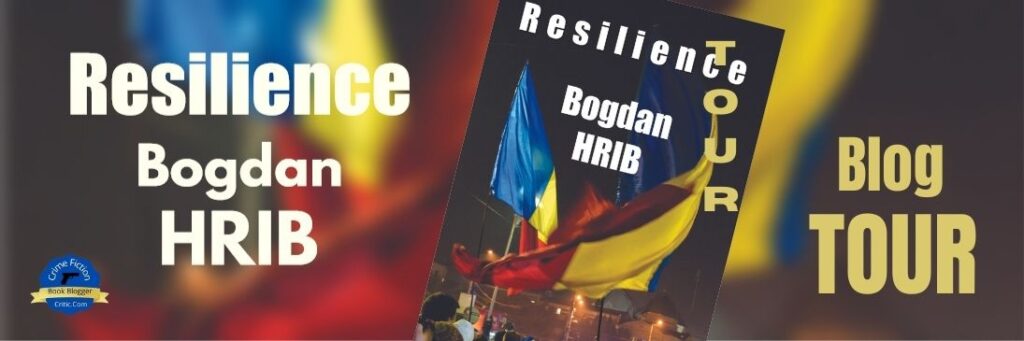
Blog Tour and Review of Resilience by Bogdan Hrib

Resilience by Bogdan Hrib—A hybrid crime fiction/political thriller set mostly in Romania and England in late 2019, is bathed in browns, shadows, and pale lighting.

resilience-by-bogdan-hrib
Resilience

by Bogdan Hrib

Translated by Marina Sofia

Published by Corylus Books

on August 20, 2021

Genre(s): Political Thrillers, International Mystery & Crime

ISBN 978-1-916-37976-3

286 pages

Stelian Munteanu has had enough of fixing other people’s problems: all he wants to do is make the long-distance relationship with his wife Sofia work. But when a notorious Romanian businessman asks him to investigate the death of his daughter in the north of England, he reluctantly gets involved once more.

This time it turns into a tangled web of shady business dealings and international politics. Moving rapidly between London, Newcastle, Bucharest, and Iasi, Resilience shows just how easy and dangerous it is to fall prey to fake news and social media manipulation.

Resilience by Bogdan Hrib is a difficult book to categorize. I jumped in when offered an advance copy for review and participation in the book tour, assuming it to be a usual crime fiction title. It’s no secret that is the focus of this book blog. But just a few chapters in, I realized that Resilience was as much a geopolitical thriller as a crime novel. That’s not a genre I read much anymore.

I admit it. Once upon a time, I was a big Tom Clancy fan. There’s no shame in that admission. Clancy wrote some brilliant political thrillers until losing his touch. Once the point arrived where the stories took a back seat to Clancy showing off how much he knew about the technical aspects of all things military, I lost interest. That’s when I turned to crime fiction. Of course, a good detective novel or crime thriller is almost always about the story and the characters, which I prefer. But I digress. Here there was plenty of a noir vibe to hold my interest.

Resilience opens with the death of a young woman, a junior staffer at the Romanian Cultural Institute; we meet in the first chapter—a death that may or may not be suspicious. Nevertheless, the woman’s father, Pavel Coman, who we learn is a wealthy (but shady) businessman, suspects foul play and employs Stelian Munteanu (the protagonist) to investigate.

Munteanu is an interesting character. The author describes him as “a man with his fingers in many pies,” which we discover is an appropriate description. Munteanu is not a licensed private detective, but a book editor and former intelligence officer who self describes as “neither a detective, nor an editor, nor a spy, nor journalist, but a little bit of each.” Dabbling in private investigations seems a side interest based on his previous occupation.

Munteanu, somewhat reluctantly, accepts the case, mostly because it requires that he travel to England where his wife Sophia lives. Because of her job, the couple lives apart. Munteanu, who feels he never spends nearly enough time with Sophia, takes the case even though he doubts anyone murdered Coman’s daughter because it offers the chance for him time to spend time with his wife in London.

As the story progresses, the mystery surrounding the woman’s death fades into the background as the plot turns more toward geopolitics, specifically Russia’s historic interference in the politics of other sovereign Eastern European countries. Don’t misunderstand. The events at the book’s opening are—in many ways—the start of everything that comes after, but it feels as if the plot is about something altogether more sinister than what we expected. Hrib gives us glimpses into it, but it feels like something is missing. That piece of the puzzle left unsaid or unexplained made me feel I entered the story late and was playing catch-up. Hrib cleverly keeps things somewhat vague for a while and the reader in suspense. We recognize that we don’t have the full story and are left waiting for more.

The plot is imaginative, and the prose well-written, which made me feel the story was well worth hanging in for to the end. But, in all honesty, this book can at times seem a bit destabilizing, confusing, and manipulative once you realize it isn’t what it seems at the start.

Our lead character Stelian Munteanu often gives way to other narrators, notably Anton “Tony” Demetriade, a police detective and Munteanu’s friend that Stelian often turns to for help with his investigation. Demetriade is such a prominent character it seems almost fair to label him the co-protagonist rather than a mere side kick. Other conspicuous narrators are Ionescu, a Romanian secret services operative, and Scotland Yard DCI Harriet Darlow.

Reminiscent of a Robert Ludlum spy novel, Resilience demands concentration from the reader as a host of characters populate the story that we must keep track of as the novel shifts quickly between settings and narrators. The plot features a fair degree of complexity, but once you get past the first few chapters, it’s oddly compelling for that reason.

There is much I liked about Resilience. It’s a twisty read told from multiple points of view by realistic and fully drawn characters. I found the character development particularly interesting, becoming far more attached to some than seemed sensible.

The book also references many contemporary issues that will be familiar to readers—climate change, Russia’s annexation of Crimea, the explosion of social and political activism produced by the internet, increasing migration and its effects, and the influence of “fake news” on politics and social unrest.

While the focus is on the Balkans, the aforementioned contemporary issues helps make the book relevant and relatable across English-speaking markets. This felt particularly relevant to me as an American in this era where the politics of balkanization (identity politics) pursued by corporate media-supported social organizations and movements to shift the balance of political power has fragmented the country into “tribes,” making many Americans hostile and uncooperative with one another.

I enjoyed Resilience even more than expected, especially since I first assumed it would be more of a traditional crime fiction novel. But that’s not at all the case. Instead, the novel is a hybrid crime fiction/political thriller, bathed in browns, shadows, and pale lighting. And the geopolitical circumstances involved are probably one of the best parts of the plot, certainly not expected at the outset; something I didn’t see coming.

Something else I hadn’t realized about Resilience is that it is the sixth book in a series featuring Stelian Munteanu. Typically, I prefer to enter a series with the first book. But, Bogdan Hrib, born in Bucharest, Romania, wrote and published the series in Romanian (obviously), and the English translations began with  Kill the General (2011), the fourth book in the series. Still, I feel the book works well as a standalone.

Resilience has garnered a lot of buzz from reviewers, book bloggers, and bookstagrammers, so I was excited to read it, though I wasn’t sure what to expect. After all, I’d not read Hrib’s books previously, and it is a translation. Unfortunately, that doesn’t always augur well. You’re at the mercy of the translator’s ability to transform not only the language but the tone and underlying nuances of the author’s original style. There were probably times early on that I was aware of reading a translation, but either the phrasing settled, or I became accustomed to the style of the author and translator as I stopped noticing part-way through, giving me confidence that translator Marina Sofia did the original justice.

What’s important is whether I liked this book. Yes, I loved it. I read it in one sitting, and the story kept me turning the pages quickly, keen to learn more. It offers something a bit new—something fresh. And, I found it a cleverly plotted book. While Resilience offers something slightly different than the reader expects at the jump, we learn fairly quickly where our assumptions are incorrect and can then settle comfortably into the story Hrib chose to tell. I loved how he brings his leading characters to life and helps the reader build relationships with them.

While presented in a fictional context, Hrib tackles a range of contemporary and complex issues with precision, challenging us to ponder our own attitudes and beliefs. This book by Romanian author Bogdan Hrib took me out of my comfort zone a bit as it departed from my steady diet of whodunits and crime thrillers. Still, I found Hrib’s writing and storytelling intelligent and easily devoured. I believe the book will satisfy political thriller and crime fiction fans alike.

Many thanks to Corylus Books for the advanced copy of the book used for this review representing my my honest and unbiased opinions.

Buy Links

Better Off Dead by Lee Child and Andrew Child

Better Off Dead by Lee Child and Andrew Child—Vintage Jack Reacher.

Better Off Dead (Jack Reacher 26)

by Lee Child and Andrew Child

Published by Penguin Random House

from October 26, 2021

Genre(s): Thriller & Suspense

ISBN 978-1-984-81850-8

400 pages

Reacher goes where he wants, when he wants. That morning he was heading west, walking under the merciless desert sun—until he comes upon a curious scene. A Jeep has crashed into the only tree for miles around. A woman is slumped over the wheel.

Dead? No, nothing is what it seems. 

The woman is Michaela Fenton, an army veteran turned FBI agent trying to find her twin brother, who might be mixed up with some dangerous people. Most of them would rather die than betray their terrifying leader, who has burrowed his influence deep into the nearby border town, a backwater that has seen better days. The mysterious Dendoncker rules from the shadows, out of sight and under the radar, keeping his dealings in the dark.
 
He would know the fate of Fenton’s brother. 

Reacher is good at finding people who don’t want to be found, so he offers to help, despite feeling that Fenton is keeping secrets of her own. But a life hangs in the balance. Maybe more than one. But to bring Dendoncker down will be the riskiest job of Reacher’s life. Failure is not an option, because in this kind of game, the loser is always better off dead.

I’ve been a Jack Reacher fan since picking up and reading Killing Floor in 2000. Afterward, I bought and binge-read the next three novels. Then, starting with Echo Burning in 2001, I bought and read every new Reacher book as soon as it came out.

When Child (James Grant) launched the series, there was no character quite like Jack Reacher. He’s an ex-military cop turned drifter who wanders the back roads of America, always finding some injustice he must put right like some modern-day mythic avenger. I think it’s fair to say that the series developed a cult-like following.

The first twenty-five books were bestsellers, with sixteen hitting the top of the list. James Grant’s nom de plume, Lee Child became one of the most recognized thriller author names on the planet. He went on to sell more than 100 million books, which have been translated into 40 languages and adapted into two movies starring Tom Cruise.

Through the twentieth novel, Make Me, the author never missed a beat. With each new installment, the writing remained tight, and the action non-stop. Once I started a Reacher novel, I didn’t want to put it down until I’d read the last page. Then something happened. The quality of the writing started to slip.

Beginning with Night School, the twenty-first novel—probably an ill-advised second prequel for such a mature series—Child took us back to Reacher’s days as an Army MP and wrote the book in the third person rather than the usual first person. As a result, Reacher just didn’t seem like Reacher, and the explosive action we were accustomed to, fizzled. Similarly, the next three novels proved equally disappointing.

In 2020, James Grant announced his days as an author were over. I’ve always marveled at authors who remain passionate about writing the same series for going on a quarter of a century with no drop-off in quality. I can think of only a few who have achieved it. Even an imaginative author who wrote as brilliantly as Grant must have found it increasingly difficult to conceive new, fresh Reacher adventures. It seemed better that he exited the stage while the books were still hitting the bestseller list on the strength of the Lee Child name than to turn out bad ones. But his retirement wasn’t the end of the Jack Reacher franchise.

In combination with James Grant’s retirement announcement, he revealed he was turning the series over to his younger brother, Andrew Grant, a thriller author of nine thrillers of his own. To maintain the consistency of the brand, Andrew adopted the pen name Andrew Child to carry the series into the future.

Although Lee Child appears on the cover as co-author, according to James, his novelist brother largely wrote The Sentinel, the twenty-fifth Reacher novel. I bought the book but couldn’t bring myself to finish it. It wasn’t that the writing was bad, but Reacher just wasn’t Reacher. When it comes to this immensely popular series, Jack Reacher is the series. Getting that right is job one.

In fairness, the family relationship aside, it is never easy for a new author to take over a series as popular as this one. Nothing against Andrew’s skills as a writer, but the change in authors in The Sentinel was far from subtle. It was glaringly detectable, and the Jack Reacher character was too different from past novels. He felt phony.

Still, I wasn’t ready to call it quits with Reacher without trying the second Andrew co-authored book. Sometimes, a new author of an existing popular series grows into the role and finds their footing. So, when I had the opportunity to snag an advance copy of Better Off Dead from the publisher, I jumped at the chance.

When Reacher hitchhikes west to see the Pacific Ocean, he encounters under unusual circumstances, Michaela Fenton in a small dead-end Arizona town on the border with Mexico. Fenton, an army veteran and former FBI agent confides she is trying to rescue her twin brother, Michael (also a veteran), who is involved with some very dangerous people. Once Reacher learns the details, he realizes that even a capable woman like Fenton won’t succeed alone against the steep odds she faces. So he decides to postpone his trip to help her out, which might turn out one big mistake.

I won’t keep you in suspense. Jack Reacher is back, the original six-foot-five, technology-challenged brawler version who captured the imagination of fans at the start. Reacher does use a cell phone a few times in this book, but still prefers getting change for payphones.

I don’t know who did the lion’s share of writing this time around, but since he is taking over the series, we must hope it was Andrew and that he has now found his stride. This twenty-sixth installment is the best Reacher novel since Make Me and every bit as good as many of the early books in the series. The writing is tight, and the action is as non-stop and explosive as ever. The plot is fresh and imaginative, and there is plenty of suspense.

Reacher is always going to be my favorite character in this series. He’s the whole point of reading the books. But, in this one, I really liked Michaela Fenton. She’s no damsel in distress but a strong female character capable of holding her own when the numbers are reasonable. But facing an army of bad guys, she needs help as anyone would. We meet other fascinating characters along the way.

My recommendation, if you’re a fan of this series, whether you liked The Sentinel or had trouble getting into it as I did, is to get this book. Reacher is back. Those who have never read a Jack Reacher novel but enjoy a gripping, suspenseful thriller will also enjoy Better Off Dead.

Better Off Dead by Lee Child and Andrew Child is published by Penguin Random House and is available from October 26, 2021. I received an advance copy of the book used for this review from the publisher via NetGalley, representing my honest, unbiased opinions.

Buy Links

Snare by Lilja Sigurðardóttir

Snare by Lilja Sigurðardóttir—Classic Sigurðardóttir, a pleasure read for her fans, and not a bad place to start if you’re new to her.

Snare (Reykjavik Noir Trilogy)

by Lilja Sigurðardóttir

Translated from Icelandic by Quentin Bates

Published in English by Orenda Books

on September 12, 2017

Genre(s): Thriller &Suspense, Nordic noir

ISBN 978-1-910633-81-6

After a messy divorce, young mother Sonia is struggling to provide for herself and keep custody of her son. With her back to the wall, she resorts to smuggling cocaine into Iceland, and finds herself caught up in a ruthless criminal world.

As she desperately looks for a way out of trouble, she must pit her wits against her nemesis, Bragi, a customs officer, whose years of experience frustrate her new and evermore daring strategies. Things become even more complicated when Sonia embarks on a relationship with a woman, Agla. Once a high-level bank executive, Agla is currently being prosecuted in the aftermath of the Icelandic financial crash.

Set in a Reykjavík still covered in the dust of the Eyjafjallajökull volcanic eruption, and with a dark, fast-paced and chilling plot and intriguing characters, Snare is an outstandingly original and sexy Nordic crime thriller, from one of the most exciting new names in crime fiction.

Ordinarily, in the interest of variety, I don’t read and review two books in a row by the same author. However, here I make the rare exception. Icelandic author Lilja Sigurðardóttir is the newest among my favorite crime writers. After devouring her most recent (and absolutely brilliant) release, Cold As Hell, I simply couldn’t wait for more Sigurðardóttir. Snare had been on my TBR pile for a while, so I tucked in to it straight away.

After being caught out in a sexual affair with another woman, our protagonist, Sonja Gunnarsdóttir, is in dire straits. Because she has no ready prospects for supporting herself, her enraged husband Adam sues for custody of their nine-year-old son, Tómas.

Out of the blue, Thorgeir, an attorney who studied law with Adam, calls expressing sympathy over the bitter divorce proceedings Sonja faces. He generously offers legal help. Desperate and without thinking twice, Sonja places her fate in his hands. But, not only does she get the wrong end of the stick in the divorce proceedings—losing custody of her son, Thorgeir turns out involved in the drug trafficking. He pressures Sonja to become a drug mule to pay her legal fees and child support. Lacking other options, she agrees and regularly risks prison running the gauntlet of Iceland’s Directorate of Customs while smuggling copious amounts of cocaine into Iceland from other European countries. While Sonja dreams of escaping Thorgeir’s clutches and getting her son back, the truth is, she is snared.

Although quite a different novel from Cold As Hell, Sigurðardóttir again offers us a likable but flawed female lead and then bounces her off several strong personalities that bring out her best and sometimes her worst. These others include her ex-husband Adam, Thorgeir, Thorgeir’s cruel enforcer Ríkharður, and to an extent, her lover Agla. But, I very much liked Sonja’s character development arc, which complements the unfolding story.

Also, as in Cold As Hell, Sigurðardóttir again masterfully uses multiple points of view and the inner thoughts of several key players to create layered, fully developed characters. We don’t necessarily like or emphasize with them all, yet we can’t help connecting with them and caring about what happens to them, whether for better or worse. In Sonja’s case, we’re taken aback by her drug smuggling, but naturally feel sympathetic toward her and hope she isn’t caught. Also, I couldn’t help admire the clever ways she invented to escape the detection of the customs officials. The author uses that empathy to steadily ratchet up the tension, which builds and builds relentlessly each time Sonja returns to Iceland with a load of cocaine.

Not only a novelist, Sigurðardóttir is also a screenwriter, which I think goes a good way toward explaining how skillfully she breathes life into her characters. In novels, characters are mostly revealed through description and internal monologue, whereas screenwriters develop their characters primarily through action and dialogue. Sigurðardóttir uses this screenwriting technique to excellent effect in her novels. We get the descriptions and inner thoughts of the characters, but their actions and dialogue add additional layers to our understanding of them. That makes them seem incredibly real.

While I really liked Sonja’s character development, and her interactions with those around her were a major strength of this novel, my favorite character in the book was Bragi, a sixty-nine-year-old customs officer, who is the subject of one of the novel’s fascinating subplots. Despite his age and that the directorate is pressuring him to retire, Bragi is an intelligent and seasoned officer who works out that Sonja is a big-time smuggler. Once we learn this, the tension grows to epic proportions as Bragi becomes her chief nemesis.

Here again, Bragi is a character who we quickly start caring about. We discover his elderly wife, in the advanced stages of Alzheimer’s disease, is institutionalized in a care home where she is mistreated. His wife’s condition sucks the very life out of him, yet he balances caring for his wife with doing his duty, both to the best of his abilities.

The novel is set in a ReykjavÍk still covered in the dust of the 2010 EyjafjallajÖkull volcanic eruption. This, along with the frequent mention of the cold and ice of Iceland, compliments the dark, chilling plot to provide us an authentic Nordic noir experience. Once again, Lilja Sigurðardóttir delivers a brilliantly plotted thriller with suspense that feels palatable. While a translated novel can sometimes feel a bit a off, this one was translated from Icelandic by the incomparable Quentin Bates. As a result, it feels smooth as silk.

Snare is certainly a gripping read, and Lilja tosses in a couple of twists near the end that totally blindsided me but delighted me at the same time. The book also offers some commentary on popular culture today, which is certainly worth the discourse. Snare is classic Sigurðardóttir, a pleasure read for her fans, and not a bad place to start if you’re new to her.

Snare by Lilja Sigurðardóttir is published in English by Orenda Books and is available in electronic and print versions. I purchased the copy of the book used for this review representing my honest, unbiased opinions.

Buy Links

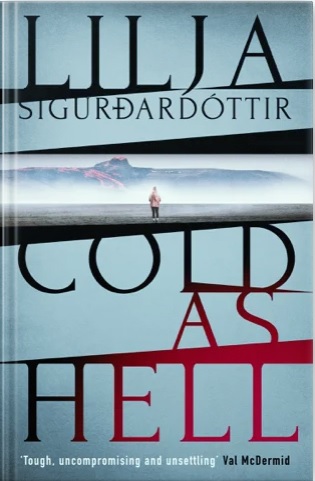
Cold as Hell by Lilja Sigurðardóttir

Cold as Hell by Lilja Sigurðardóttir—A smart, creative series start from one of Iceland’s bestselling crime writers at the top of her game.

Cold as Hell (An Áróra Investigation Book 1)

by Lilja Sigurðardóttir

Translated by Quentin Bates

Published by Orenda Books

on August 28, 2021

Genre(s): Thrillers & Suspense, Nordic noir

ISBN 978-1-913-19388-1

“Icelandic sisters Áróra and Ísafold live in different countries and aren’t on speaking terms, but when their mother loses contact with Ísafold, Áróra reluctantly returns to Iceland to find her sister. But she soon realizes that her sister isn’t avoiding her … she has disappeared, without a trace.

As she confronts Ísafold’s abusive, drug-dealing boyfriend Björn, and begins to probe her sister’s reclusive neighbors – who have their own reasons for staying out of sight – leads Áróra into an ever darker web of intrigue and manipulation.

Baffled by the conflicting details of her sister’s life, and blinded by the shiveringly bright midnight sun of the Icelandic summer, Áróra enlists the help of police officer Daníel, as she tries to track her sister’s movements, and begins to tail Björn– but she isn’t the only one watching…

Slick, tense, atmospheric and superbly plotted, Cold as Hell marks the start of a riveting, addictive new series from one of Iceland’s bestselling crime writers.”

After a rift, Icelandic sisters Áróra and Ísafold Jónsdóttir are estranged. But when Ísafold goes dark, at her worried mother’s insistence, Áróra reluctantly travels from her home in Scotland to Iceland to find out what has become of her older sister.

After a brief prologue sets the stage, we meet the protagonist, Áróra Jónsdóttir, a twenty-eight-year-old freelance financial investigator. Áróra’s mother, Violet, rings and tells her that Ísafold hasn’t posted anything on Facebook for two weeks, and Violet has been unable to reach her by phone. Certain that something is seriously amiss and frantic, Áróra’s mother urges her to go to Iceland to see if everything is all right.  

Although their relationship has been rocky since childhood, it isn’t the first time that Áróra has ridden to her older sister’s rescue. Ísafold’s partner, Björn, is abusive and battered her frequently. Several times in the past, after Björn had beaten her, Ísafold had called her sister for help. Each time, Áróra hurried to Iceland to rescue her. But, each time, Ísafold returned to Björn. Finally, fed up with the drama, Áróra refused to go to Ísafold’s aid the last time she called after Björn assaulted her, which resulted in the estrangement.

Áróra arrives in Reykjavik but soon discovers that her sister has not severed contact with her family but has disappeared without a trace. Áróra searches for concealed money for a fee, not people, and quickly feels out of her depth. After calling her mother from Iceland, Violet connects Áróra with a Reykjavik police detective, Daníel Hansson, who happens to be a former uncle by marriage. After hearing about the abusive relationship, Daníel is immediately concerned that something terrible may have befallen Ísafold. Although he is on leave, Daníel quickly starts investigating Ísafold’s disappearance informally. From there, the story unfolds from multiple points of view, all offering very different voices, personalities, and perspectives.

I really loved the way Sigurðardóttir develops the novel’s characters. She puts us into the heads of all the major players, giving them layer upon layer of life. We’ve all heard the discussions about creating unlikeable characters and whether that makes them hard to engage with or relate to. But, Sigurðardóttir certainly doesn’t shy away from giving her fascinating creations some major flaws. Even with Áróra, she offers us a strong but flawed female protagonist who is sometimes unlikeable.

The disappearance of Ísafold Jónsdóttir is at the crux of this novel. That is what unites our disparate narrators. The backstories of the lead characters are what is all-important and converge in the satisfying and unambiguous denouement. But Sigurðardóttir cleverly uses two major subplots that are almost as fascinating as the main plot. In a fashion I found similar to the novel Gone Girl, she uses the multi-viewpoints and chronologically complex narrative to create suspense by purposely misleading the reader. Since this popular device does not fool me as easily as it once did, I immediately assumed I was getting played. Still, I enjoyed the twists and revelations that followed. Cold as Hell is crime thriller storytelling at its finest.

Author and translator Quentin Bates, who translated Cold as Hell from Icelandic to English, turned in a virtuoso performance even by his high standards. The book is easy to read and smoothly put together. I read it in one sitting because I didn’t want to put it down after the opening chapters.

My verdict? Buy it! Whether you’re a fan of Nordic noir as I’ve been ever since reading my first Joe Nesbø Harry Hole novel, or just someone who loves a dark, suspenseful crime thriller with a bleak setting, Cold as Hell belongs on your must-read list. In a similar fashion to Ragnar Jónasson, another of my favorite Icelandic crime writers, Lilja Sigurðardóttir, makes you feel as though you’re in Iceland while reading the story. I can’t wait for the next book in the Áróra Investigation series.

Cold as Hell by Lilja Sigurðardóttir, translated by Quentin Bates, is published in English markets by Orenda Books and available in electronic version from August 28, 2021 and in print from October 28, 2021. I purchased the copy of the book used for this review representing my honest, unbiased opinions.

Buy Links

Pigeon-Blood Red by Ed Duncan

Pigeon-Blood Red by Ed Duncan—A noir fiction novel in its modern form that's both markedly dark in theme and subject matter and featuring the expected mixture of sex and violence.

Pigeon-Blood Red

by Ed Duncan

Published by Blurb

on August 25, 2021

Genre(s): Noir fiction, crime fiction

ISBN 978-0-692-76947-8

190 pages

Hardcover, paperback, electronic editions

“For underworld enforcer Richard “Rico” Sanders, it seemed like an ordinary job: retrieve his gangster boss’s stolen goods, and teach the person responsible a lesson.

But the chase quickly goes sideways and takes Rico from the mean streets of Chicago to sunny Honolulu. There, the hardened hit man finds himself in uncharted territory, when innocent bystanders are accidentally embroiled in a crime.

As Rico pursues his new targets, hunter and prey develop an unlikely respect for one another.

Soon, he is faced with a momentous decision: follow his orders to kill the very people who have won his admiration, or refuse and endanger the life of the woman he loves?”

I will admit when offered the noir fiction novel Pigeon-Blood Red by Ed Duncan for review, I found the title rather curious, having never heard of that particular shade of red. Frankly, when it comes to using hyphenated words in a book title, I’m not a fan. So, before reading the first page, Duncan already had something to prove to me—what on earth had possessed him to title the book Pigeon-Blood Red? But, give Ed Duncan his due. He more than adequately answers the question, and we learn why the title makes perfect sense. If you’re interested in knowing what’s behind the title, you will just have to read the book since I never intentionally include spoilers in my reviews.

Noir fiction, often confused with hard-boiled detective fiction—due to the enduring popularity of the works of authors like Dashiell Hammett and Raymond Chandler—while related, is not the same. Rather than a trench-coated, chain-smoking police detective or private eye, in noir fiction, the protagonist is usually a victim, a suspect in a crime, or a perpetrator—someone tied directly to a crime, not an outsider called upon to solve a crime or mystery. Typically, the protagonist in a noir novel must deal with some corrupt system that either has victimized them or compels them to victimize others, often leading to a lose-lose situation. Pigeon-Blood Red by Ed Duncan, set in contemporary Chicago, is just such a novel.

The story kicks off with our introduction to Jerry Gilbert and Richard “Rico” Sanders. Even before we know who these men are exactly and what they do for a living, you get the feeling that Rico, at least, is likely a criminal of some type. Yet, in the opening scene, when Rico intervenes in a situation where a man treats his wife most unkindly outside an apartment building, we also learn that Rico is no common thug but a man of principle. A few paragraphs later, Rico leaves no doubt, morals or not, that he indeed is a bad man prone to violence when he feels it necessary.

A few pages later, we discover that Jerry and Rico both work for a mobster named Frank Litvak, who, among other things, is a loan shark. While it seems Jerry is only a garden-variety, small-time crook, Rico turns out to be a .45 packing mob enforcer and shooter for hire.

Litvak sends Jerry and Rico to haul in a man, Robert McDuffie, for a talk. Robert is a man with high aspirations but a ne’er-do-well nevertheless who has never achieved his lofty goals, mostly due to spending far too much time at the racetrack gambling badly, drinking, and cheating on his wife, Evelyn. Also, he made the bad decision to borrow money from Litvak.

After extracting Robert’s promise to pay him what he’s owed, Litvak entrusts Jerry and Rico with a very valuable piece of jewelry, a necklace. Rico hands the piece over to Jerry for safekeeping, and the pair drive Robert back to where they collected him. Along the way, the item slips from Jerry’s pocket and ends up on the backseat floorboard where Robert spies it. Knowing he has no hope of finding the money to keep his agreement with Litvak, Robert gives in to temptation and steals the valuable necklace.

Once they discover the loss of the necklace and break the news to Litvak, the mobster orders Jerry and Rico to recover it. They quickly identify Robert as the likely suspect and feel confident they will get the necklace back in short order. But, Robert has other ideas and flees Chicago with the necklace.

Then the setting shifts from Chicago to Honolulu, with Rico hot on Robert’s trail. There we meet Robert’s wife, Evelyn, and her friend Rachel. We also meet another very interesting character, Paul Elliott, a successful Chicago attorney vacationing in Honolulu. Elliott, we learn, has recently lost his beloved wife in a tragic accident. He goes to Honolulu in an attempt to come to grips with his grief. There he runs into Evelyn by chance, and we discover Elliott was in love with Evelyn in years past when she, Robert, and Elliot all attended the same university.

Rico locates Robert but fails to recover the necklace. A couple of murders later, Rico returns to Chicago without it, though certain he knows who has it and that the necklace will eventually show up back in Chicago.

Rico, clearly the protagonist in the book, was my favorite character. Despite his vocation, I couldn’t help feeling a tiny bit of admiration for him because he did have a code he embraces. While his job means Rico is on the wrong side of the law and kills people without blinking an eye, he is very pragmatic and business-like about his work, much like Robert B. Parker’s character, Vinnie Morris. In other words, he isn’t simply a psychopath who kills thoughtlessly or out of enjoyment. From about midway through the book, you sensed you would find some good in Rico before the book ended.

Pigeon-Blood Red has a host of well-developed, believable characters. Duncan gives us plenty of background so that the reader finds the characters realistic but never uses information dumps. Instead, he works in the background where it makes sense. This isn’t a thriller, nor meant to be, so don’t expect an edge-of-your-seat thrill ride. But do expect a gripping story with plenty of suspense and drama that keeps the reader turning the pages. Duncan takes us all the way home with a powerful and satisfying conclusion.

This book was my first read by Ed Duncan, but I’ll certainly be looking to read more of his work as time permits. I find him a skillful writer and attention-gripping storyteller. There may not be any cynical private eyes in this novel, but Ed Duncan’s writing style reminds me quite a lot of Dashiell Hammett. This book is a noir fiction novel in its modern form that’s both markedly dark in theme and subject matter and featuring the expected mixture of sex and violence that should satisfy the most demanding noir fiction fan.

Pigeon-Blood Red by Ed Duncan, published in the United States by Blurb on August 25, 2021, is on sale now.

I received an advance copy of the book used for this review from the publisher via the publicist, representing my honest and unbiased opinions.

Buy Links

The Fields by Erin Young

The Fields by Erin Young—A gritty but flawed heroine propels this dark, imaginative thriller.

The Fields

by Erin Young

Published by Flatiron Books (MacMillian Publishers)

On Sale January 25, 2022

Genre(s): Mystery & Thriller

ISBN 978-1-250-79939-5

352 pages

Some things don’t stay buried.

It starts with a body—a young woman found dead in an Iowa cornfield, on one of the few family farms still managing to compete with the giants of Big Agriculture.

When Sergeant Riley Fisher, newly promoted to head of investigations for the Black Hawk County Sheriff’s Office, arrives on the scene, an already horrific crime becomes personal when she discovers the victim was a childhood friend, connected to a dark past she thought she’d left behind.

The investigation grows complicated as more victims are found. Drawn deeper in, Riley soon discovers implications far beyond her Midwest town.

The Fields by Erin Young, who also writes historical fiction as Robyn Young, is the author’s debut crime thriller. The book, featuring Sergeant Riley Fisher of Black Hawk County (Iowa) Sheriff’s Office, is the latest in a series of entertaining thrillers I’ve read recently.

I was worried this book might be a bit predictable, from the title and knowing the genre. The premise seemed obvious. I expected the cops would discover the body of a murder victim in a remote field somewhere and then set about trying to solve the crime and identifying the killer. As someone who reads many crime thrillers, it wasn’t like I haven’t been there before. But, as I read the publisher’s synopsis, I found an interesting twist.

I learned that the story is set in rural Iowa and that a farmer discovered the expected murder victim in the cornfield of a family farm struggling to exist against the competition with the giant corporate farms of Big Agriculture. I found this compelling since most crime thrillers today are set in large, well-known cities with huge law enforcement agencies investigating the crimes. Finding a novel set in the rural heartland of America with a small county law enforcement agency investigating a horrific murder was a welcome change of pace.

I like that Young sets the stage quickly. When Sergeant Fisher, newly promoted head of the Black Hawk County Sheriff’s Department investigations division, arrives on the scene of a gruesome murder, she discovers the victim is an old friend she grew up with. We soon learn that it complicates things for Fisher since it dredges up troubling memories of events from her past, memories of the worst thing that ever happened to her and nearly destroyed her life.

Young provides us the details of the past and present gradually in such a way that kept me riveted. I really liked this book because, though we’re kept in suspense about exactly what’s going to happen in the future, it highlights how the events of the past impact the way the story unfolds.

The Fields is a thriller as much about human nature and behavior and relationships as about unraveling secrets and mysteries and the eventual outcome of a criminal investigation. Here there’s a strong sense of grief and guilt as Young takes us into the mind of Riley Fisher, and we learn more about her childhood, adolescence, and her relationship with her family. Riley is a flawed and tortured heroine for reasons not all of her own making. But, she earned my empathy as she doggedly and courageously works to suppress the horrific memories of her past to lead her team in the investigation of what turns out a string of seemingly related murders.

Young kept me engaged as the story unfolded and often surprised me with intricate and compelling twists along the way. I also liked the support characters, including Riley’s partner Logan Wood, her brother, Ethan, a troubled addict, and her niece Maddie. Riley’s interactions with Ethan allow the reader insight into how the baggage they both carry from the past informs how they relate to each other.

Young paces the story well and keeps the twists coming, ultimately taking the reader in unexpected directions. While dark and at times devastating, the book is at the same time touching and uplifting. This novel, a strong debut in a planned series, is perfect for anyone who enjoys a suspenseful crime thriller with a strong female lead.

The Fields by Erin Young will be published in the United States by Flatiron Books, a division of Macmillan Publishing, and goes on sale on January 25, 2022.

I received a copy of the book used for this review from the publisher via Net Galley, representing my honest and unbiased opinions.

Buy Links

The Killing Kind by Jane Casey

The Killing Kind by Jane Casey—essential reading for every psychological thriller fan who enjoys a dark story where the tension builds to almost unbearable levels.

The Killing Kind

by Jane Casey

Published by Harper Collins Publisher

On Sale September 21, 2021

ISBN: 978-0-00840-492-5

Genre(s): Psychological Thriller, Thriller & Suspense

480 pages

Hardcover, paperback, electronic, and audiobook versions available.

He tells you you’re special…

As a barrister, Ingrid Lewis is used to dealing with tricky clients, but no one has ever come close to John Webster. After Ingrid defended Webster against a stalking charge, he then turned on her – following her, ruining her relationship, even destroying her home.
 
He tells you he wants to protect you…

Now, Ingrid believes she has finally escaped his clutches. But when one of her colleagues is run down on a busy London road, Ingrid is sure she was the intended victim. And then Webster shows up at her door…
 
But can you believe him?

Webster claims Ingrid is in danger – and that only he can protect her. Stalker or saviour? Murderer or protector? The clock is ticking for Ingrid to decide. Because the killer is ready to strike again.”

Like many good thriller, The Killing Kind by Jane Casey opens with a suspicious death. We just aren’t certain at the start whether the death is a horrific accident or a murder.

In the first chapter, we met the central character, Ingrid Lewis, a London barrister. Lewis is a tenacious lawyer who is good at her profession, and she likes to win. When she arrives at court, she runs into a fellow barrister, Belinda Grey, a more senior lawyer Lewis once seconded on a rape trial. Grey is on her way out following a brief hearing. After a brief catch-up, when Lewis learns Grey arrived without her umbrella, she insists that Grey take hers since it’s pouring rain outside. Lewis believes the rain will end before she finishes her hearing. Grey agrees, takes the umbrella, and departs. Following the hearing, Lewis is horrified to learn that Grey died in an auto-pedestrian accident on the way back to the office. Fearing that the umbrella may have blocked Grey’s vision, causing her to step off the curb of a busy street in front of the truck that struck her, Lewis feels unsettlingly responsible for her colleague’s death.

The novel then dips two years into the past—via Lewis’ memories of another past court case where she defended a man named John Webster on stalking charges. After Lewis destroys the female victim on the stand, the court acquits Webster. While he beats that rap, thanks to Lewis, it’s clear from the trial testimony that Webster is an evil sociopath. Almost predictably, after the trial, Webster turns his obsessive tendencies on Lewis and starts stalking and harassing her.

As the story continues, we learn from Lewis’ perspective how Webster’s terrorizing activities come close to destroying her life completely and leave her living in abject fear, clinging to her sanity by a thread. Perhaps the worst part of it is that Webster is so skilled at covering his tracks that even the police don’t fully believe Lewis, which adds to her anguish. Frankly, as the months transform into years, there is a point where even the reader starts to doubt her sanity to the point that Lewis becomes almost an unreliable narrator.

While the novel is gripping from the jump, Jane Casey effectively lulls the reader into a false sense of security with the initial chapters, but when she punches the gas pedal, the suspense and tension accelerate from zero to sixty in an instant. As we await potentially fatal outcomes, some of humanity’s most powerful emotions play out on the page.

To describe The Killing Kind using standard clichés like “nail-biter” or “edge of your seat” would be a disservice to the book. Those terms wouldn’t even begin to adequately describe the trepidation, tension, and sense of foreboding this novel generates for the reader. Jane Casey is an artist who expertly employs tension as her medium. We become her canvas. I recall few thrillers I’ve read in the past that accomplished this so effectively. I had to read the book in two sittings, not because it failed to hold my attention, far from it. It’s wickedly good. I simply had to take a break from reading.

Halfway through the book, I developed what I’m sure was a tension-related headache on the first day. I rarely ever get headaches for any reason, which should tell you much about this endlessly tense novel. Only the novels of Norwegian writer Jo Nesbø have ever affected me this way.

All I have to say after reading The Killing Kind is, Jane Casey, where have you been all my life? I can’t imagine how difficult it will be to find another thriller to read this year that will even come close to the gut punch this book delivers. But now that I’ve discovered this Irish -born author, I’ve happily learned she has many other novels I’ve yet to read. The Killing Kind by Jane Casey is essential reading for every psychological thriller fan who enjoys a dark tale where the tension builds to almost unbearable levels.

The Killing Kind by Jane Casey (Harper Collins Publisher) goes on sale September 21, 2021. It’s not to be missed by fans of the genre.

The publisher provided me an advance reader copy of the book for this review, representing my honest, unbiased opinions.

Buy Links

Robert B. Parker’s Stone’s Throw by Mike Lupica

Robert B. Parker’s Stone’s Throw by Mike Lupica—another installment in a standout series guaranteed to please Parker fans and other mystery & detective enthusiasts alike.

Jesse Stone Series
Robert B. Parker’s Stone’s Throw

by Mike Lupica

Published by Penguin Random House

on September 7, 2021

Genre(s): Crime Mysteries, Suspense & Thriller, Police Procedural

ISBN: 978-0-525-54211-7

Pages: 336

Hardcover, electronic, and audio versions.

Paradise is rocked by the mayor’s untimely death in the latest novel starring police chief Jesse Stone.

The town of Paradise receives a tragic shock when the mayor is discovered dead, his body lying in a shallow grave on a property on the lake. It’s ostensibly suicide, but Jesse’s has his doubts . . . especially because the piece of land where the man was found is the subject of a contentious and dodgy land deal.

Two powerful moguls are fighting over the right to buy and develop the prime piece of real estate, and one of them has brought in a hired gun, an old adversary of Jesse’s: Wilson Cromartie, aka Crow.  Meanwhile, the town council is debating if they want to sacrifice Paradise’s stately character for the economic boost of a glitzy new development. Tempers are running hot, and as the deaths begin to mount, it’s increasingly clear that the mayor may have standing in the wrong person’s way.”  

There is an old-fashioned land war going on in Paradise, Massachusetts. Two shady rich businessmen, one a mobbed-up Las Vegas guy and the other a disreputable Boston developer are vying to buy a valuable, choice piece of Paradise beachfront property, nicknamed Throw Beach, with the intent of developing it and building a hotel and casino there. The townspeople are divided. Some view the proposed development and the promised jobs as just what Paradise needs to bring the town’s COVID-19 damaged economy back to prosperity. Others, particularly a local environmentalist group called Save Our Beach, rabidly opposes the development. When they register their opposition by vandalizing the property with a series of shallow graves and headstones, the property owner, Thomas Lawton, demands that Jesse Stone, the Paradise police chief, stop the shenanigans of the “tree huggers” by throwing them in jail. Unfortunately, when Stone visits the property to view the newest grave, he finds a body inside it—the body of a friend, the town’s mayor, Neil O’Hara, with a bullet wound to his right temple and a pistol near his right hand. The only problems with the apparent suicide is that Stone knows O’Hara was left-handed and the angle of the shot is all wrong. Aware that the mayor was one of the few city government officials who opposed the land sale and impending development, Stone smells a rat, maybe two. He feels sure someone murdered his friend or had him killed and staged it as a suicide to erase O’Hara as an obstacle to the planned land sale. Jesse mobilizes his small police department to prove it and to bring the killer to justice.

It wasn’t until after I read Robert B. Parker’s Stone’s Throw by Mike Lupica that I learned the book isn’t his first Jesse Stone novel. Instead, it is the second book by Lupica since Parker’s estate commissioned him to continue the popular series. I discovered the first Jesse Stone novel penned by Lupica, Robert B. Parker’s Fool’s Paradise (G.P. Putnam), was published September 8, 2020. How could I have missed that! Nevertheless, I eagerly anticipated my first look at Lupica’s writing in the series as soon as I saw the ARC for Stone’s Throw listed on Net Galley.

Previously, Parker’s estate had already chosen Lupica, a veteran sportswriter and established sports novelist (and long-time friend of Parker), to continue Parker’s Sunny Randall series. Lupica has since written three Sunny Randall novels. Having read and enjoyed them all, I felt confident Mike Lupica was a good choice to continue the Jesse Stone series. He did not disappoint.

While it’s clear Lupica has his own appealing writing style, he admirably retains many of the late, great Robert B. Parker’s stylistic touches—wisecracking characters, humorous banter, short sentences, and short chapters. He also faithfully renders the Jesse Stone series characters.

Having been a Robert B. Parker fan for decades since reading my first Parker book, The Godwulf Manuscript, I consider myself something of a Parker expert. I have read and reread every one of his novels, including those written by other authors commissioned to continue the Parker legacy of top-notch crime fiction since his untimely death. While Parker’s Spenser series, featuring the wisecracking Boston P.I., is my all-time favorite, Jesse Stone runs a close second. Not only have I read all nine of the original Stone novels Parker wrote, but I’ve also watched all nine of the Jesse Stone made for television movies starring Tom Selleck. Perhaps because of the films and how perfectly Tom Selleck matches my mental image of the Jesse Stone character, my judgment of how well another author faithfully captures the character is whether reading Stone’s dialogue in a novel produces Selleck’s image in my mind. Lupica passes this test with flying colors. I think he does equally well in capturing the essence of Molly Crane, Luther “Suitcase” Simpson, Jesse’s therapist, Dr. Dix, and the other recurring series characters.

Those who have read the Lupica penned Sunny Randall novels know that Stone and Randall are romantically entwined and that there is a significant overlap between the series. In my opinion, this is yet another reason why Mike Lupica, besides his excellent writing skills, is the natural choice to continue both series.

As Ace Atkins has done with the Spenser series, Lupica has captured the essence of Parker’s characters and stylistic prose. Reading Stone’s Throw left me feeling I was visiting familiar old friends, which is what I was hoping to experience. Jesse remains the flawed hero, battling his alcohol addiction and failed romantic relationships, but also the amiable former LAPD homicide detective who took the job as chief of police in Paradise to make a new life start. Just like Robert B. Parker’s books, I devoured this novel in one sitting. It’s sure to be a hit with Parker fans and anyone who enjoys a solid mystery & detective novel.

I’m looking forward already to reading Lupica’s next installment in the series. In the meanwhile, I’m grabbing a copy of the book I missed, Fool’s Paradise.

I received an advanced reader copy of the book from the publisher for this review, representing my honest and unbiased opinions.

Robert B. Parker’s Stone’s Throw by Mike Lupica is set for release by Penguin Random House on September 7, 2021 (Pre-orders available).

Buy Links

Paradise Palms: Red Menace Mob by Paul Haddad

Paradise Palms: Red Menace Mob by Paul Haddad—an ingenious hard-boiled noir crime fiction novel that is both confronting and fascinating.

Paradise Palms: Red Menace Mob

by Paul Haddad

Published by Black Rose Writing

on July 8, 2021

Genre(s): Hard-boiled noir crime fiction, Organized crime

ISBN: 978-1-684-33720-0

Pages: 295

Print and electronic versions

“It is October 1957. A time of Eisenhower conformity, police and mob strongholds, and Red Scare paranoia. A relic of Hollywood’s Golden Age, the aging Paradise Palms Hotel is on the brink of change. David Shapiro—eldest son of recently widowed Max Shapiro—has assumed a leadership role. But the more he digs into the hotel’s business, the more he questions who his father is. It’s not just the tenuous ties to gangster Mickey Cohen, who is trying to commandeer “the Palms,” but also the sudden appearance of a mysterious African American guest named Rae Lynn, who improbably rises in stature. As long-buried secrets come to light, David’s battle to keep the family intact takes a tragic turn. His actions mirror an America lurching from the surface simplicity of the ’50s to the turmoil of the 1960s in this riveting neo-noir family saga.”

The book, set in 1957 Los Angeles, is the story of a Jewish family that owns and operates a motel in Hollywood called Paradise Palms.

Like Hollywood itself, the motel has seen its better days and is in steady decline. When Marta Shapiro, the matriarch of the family, dies, it seems clear that her elderly husband Max, because of old age and the distractions of his 29-year-old bimboish, gold digging girlfriend, cannot keep Paradise Palms afloat financially on his own. So, David, Leo, Aaron, and Rudy, the four Shapiro brothers, pitch in to help run the place, intent on saving their inheritance.

The story unfolds from multiple points of view, though mostly from David’s, the eldest Shapiro brother. He is the closest to being the book’s protagonist, although all the siblings play important roles for different reasons.

Besides the Shapiros, Paradise Palms: Red Menace Mob has a host of other interesting, fully developed, realistic characters—from key motel staff members to a self-styled “facilitator,” Vance “Red” Gordo. Gordo, it turns out, is a small-time hood with connections to Los Angeles organized crime. One of the book’s early mysteries the Shapiro brothers face is why their father Max has some deep, unexplained connection to Gordo and insists on doing business with him despite Gordo being an obvious crook. The Shapiro brothers and the reader come to understand the connection as the story plays out.

David Shapiro is my favorite character in the book. As the eldest, he feels a heavy responsibility to save the family business from bankruptcy and looking out for his siblings. We learn David was something of a father figure to his brothers during their growing up years because Max Shapiro was an emotionally distant parent, often absent because of his involvement in extra-marital affairs. David always had ambition, but his entire life was dogged by ill fortune, and he never quite succeeded at anything, causing him to feel he is cursed.  But, David eventually becomes a prototypical reluctant hero when circumstances leave him no choice.

The promo material for the book bills Paradise Palms: Red Menace Mob as hard-boiled noir crime fiction. While I don’t argue the correctness of that genre classification, don’t approach the book expecting to find a Philip Marlowe or Sam Spade-like character. There is neither a cynical gumshoe nor a world-weary police detective character in this book, which is what comes to mind when I think of hard-boiled noir crime fiction. Still, the book earns its hard-boiled noir crime fiction spurs in the sense that to its core, Paradise Palms is dark, grim, urban gothic, gritty, and unsentimental.

Frankly, little action takes place in the first several chapters or so, usually a deal-breaker for me as a reader. Instead, the author deftly captures and keeps the reader’s attention with building the setting, fleshing out the characters, and providing backstory that proves important to understand what comes later. And, the action one expects from a novel in this genre does appear near the midpoint.

The way Haddad tells his story is striking, and the beauty of this book is in his writing. It’s haunting and gritty and quite often feels hopeless. It feels as if the words weigh more than they should. They both burdened me and transported me—not just to 1957 Los Angeles and the Shapiro’s world, but to a place requiring something of me.

Haddad does a masterful job accurately portraying 1957 Los Angeles and Hollywood, touching on nearly every defining cultural aspect of the times—Los Angeles mobsters, LAPD corruption, racism, bigotry, the space race, and the early days of the Cold War with its fears of nuclear annihilation. In addition, the book features prominent locations in and around Los Angeles that will be familiar to any reader knowledgeable of the city. From those perspectives, Paradise Palms is one of the best books set in Los Angeles I’ve read in a long while.

This novel could feel depressing, but I see it as reflective. It asks something of the reader that is both confronting and fascinating. While a work of fiction, I feel Paradise Palms is quite an instructive read in these overly politicized times where pseudo-intellectual, self-serving activist shills repeat their nonsensical mantras about how America was founded on racism and remains irredeemably mired in racism and bigotry. Haddad exposes much of the ugliness present in Los Angeles and the country in the 1950s. But, even a cursory comparison between the cultural realities of 1957 as accurately depicted in this novel and today’s circumstances amply demonstrate just how far our society has progressed in the right direction over the past six decades.

When it comes to hard-boiled noir crime fiction, don’t expect you will be reading Chandler or Hammett if you pick up a copy of Paradise Palms: Red Menace Mob. But don’t be surprised if you find similarities here to the works of another giant in the genre, Elmore Leonard. Approach the book with patience and without preconceptions, and it will reward you. It’s a fine novel that captures and holds your interest to the end.

Paradise Palms: Red Menace Mob by Los Angeles Times bestselling author Paul Haddad, and published by Black Rose Writing, is now available.

I received a copy of this book from the publicist for this review, representing my honest and unbiased opinions.

Buy Links
You Love Me by Caroline Kepnes

You Love Me by Caroline Kepnes—A stalker romance thriller that's more than a bit jarring, but in a good way.

You Love Me

by Caroline Kepnes

Published by Random House

on April 6, 2021

Genre(s): Psychological Thrillers

ISBN: 978-0-593-13378-1

Pages: 400

“Joe Goldberg is done with the cities. He’s done with the muck and the posers, done with Love. Now he’s saying hello to nature, to simple pleasures on a cozy island in the Pacific Northwest. For the first time in a long time, he can just breathe.

He gets a job at the local library—he does know a thing or two about books—and that’s where he meets her: Mary Kay DiMarco. Librarian. Joe won’t meddle, he will not obsess. He’ll win her the old-fashioned way . . . by providing a shoulder to cry on, a helping hand. Over time, they’ll both heal their wounds and begin their happily ever after in this sleepy town.

The trouble is . . . Mary Kay already has a life. She’s a mother. She’s a friend. She’s . . . busy.

True love can only triumph if both people are willing to make room for the real thing. Joe cleared his decks. He’s ready. And hopefully, with his encouragement and undying support, Mary Kay will do the right thing and make room for him.”

When his ex-girlfriend Love Quinn permanently bars Joe Goldberg from any involvement in their young son’s life, Quinn moves to Bainbridge Island, near Seattle, licking his wounds. Joe begins volunteering at the local library, where he quickly becomes obsessed with librarian Mary Kay DiMarco, mother of Nomi, a defiant teenager whose favorite book is Columbine.

Since this is the first Caroline Kepnes book I’ve read, I didn’t realize at the outset that You Love Me is the third novel in a series featuring Joe Goldberg or that there is a Netflix series based on the books. So, I was completely unaware of the character’s troubling backstory. On one level, that was great for me because, in the beginning, I assumed Joe was a “normal” lonely guy for whom I felt a good bit of sympathy given his forced estrangement from his son. But little by little, as the author teases out the fragments of Joe’s troubling past and personality disorder, it becomes clear that Goldberg is not only quite delusional but perhaps more than a little dangerous. This becomes more and more evident as his obsession with Mary Kay grows, and he begins stalking and manipulating her to fulfill his own delusional fantasies. Not to mention his frequent thoughts of committing murder.

Usually a fast reader, it took me several sittings to read this book. That wasn’t because I found it insufficiently engaging, but because this author’s rather unique writing style, at least as used with this book, demands substantial focus. You Love Me isn’t a light, engaging beach read you can skim through because you will miss too many of the more subtle nuances. I attribute that to the author’s method of putting the reader into Joe’s delusional mind by writing the novel in a second-person point of view. Thus, we become privy to virtually Joe’s every thought along with his habit of moderating many of his thoughts when responding to the other characters.

You Love Me is a twisty, creepy, suspenseful, and entertaining read that should satisfy the most demanding psychological thriller fan. Free from the bias that inevitably comes from reading the previous books in the series or acquaintance with the Netflix series, I feel the book holds its own as a standalone novel. For those reasons, I probably rate it a bit higher than others who have reviewed it. On some levels, I think the book is quite brilliant.

You Love Me by Caroline Kepnes was published by Random House and is now available. I received an advance copy of the book from the publisher via NetGalley used for this review, which represents my honest opinions.

Buy Links